Showing posts with label seo. Show all posts

Monday, May 6, 2013

Reduce validation errors of your Blogger blog

If you are aware of SEO (Search Engine Optimization) you would be aware that having less validation errors will ensure that your website has better authority than other websites having the same subject.

If you try to validate the code of a blogger blog's generated code a number of errors would be returned.
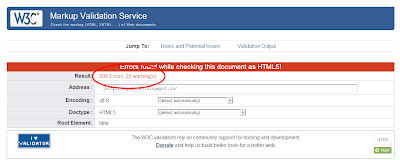
Validation errors returned by W3C HTML validator
One of the main reasons of errors is the doctype that is declared at the start of the template for blogger. 

Steps to improve the validation of blogger blog


  1. The first step to improve the validation of the HTML code generated by Blogger is to change the doctype.  Delete all the code before the <head> tag at the start of the template. The template code can be accessed by  going to the template link provide in the backend of the blog. Replace the deleted code with the following code
    <!DOCTYPE html>
    <html lang='en'>
    
  2. Find the following code
    <b:include data='post' name='postQuickEdit'/>
    and delete the code. Remember deleting this code would not allow you to edit any code from the front   end. You can edit the codes from the back-end though. 
  3. Do not allow links in the comments. Links in the comments result in non validated HTML code therefore you should ensure that you do not allow any HTML links in the comments on your blog.
To conclude a default blogger template does generate invalid HTML Code which results in lower site crawl rates and higher page load times. If the validation errors are fixed, by following the steps above, then you have a chance of getting a better A blogger template XHTML by default produces invalid results which affects your sites crawl rate and also loading time. By fixing /minimizing invalid XHTML errors you can do better in SERP's to have a nice flow of search engine's traffic to your blog.

Wednesday, December 19, 2012

Using Blog directories

What is a blog directory? 

A blog directory is a list of blogs on the Internet which are categorized for easy browsing. Some of the directories also rank different blogs based on different parameters such as traffic, followers and how often the content is updated. Usually blog details are submitted by bloggers. Some of the blog directories verify the submissions made to ensure that spam is not posted on the directory while there are other directories on submission publish the listing. Of course moderated blog directories are more popular that auto approve directories.

Submitting to Blog directories as SEO strategy

Submitting your blog to blog directories helps as far as SEO is concerned as not only do you get backlinks but you will get real visitors from good and reputable directories. The other advantages are


  • With sole purpose of exposure and traffic.
  • With good reputation and high traffic.
  • If paid directory, well and good. Paid fee shouldn’t be refundable, irrespective of listing.
  • The paid fee should be for the editorial review, not for the link.
  • Max. no. of directories submission should be 5 to 7.
  • The directory should have a past history of rejecting submissions.
  • Checkout their editorial-policies – Are they obeying Google’s (SEs) guidelines?
  • Checkout the sites they are listing – Are they high quality and authoritative?
  • Check, whether the directory is penalized by Google. Search for site:domain name.com on the Google Search, and check how many pages are indexed/showing.
  •  heck, whether the directory is offering Guaranteed Premium listing for higher fee? If yes, stay away from it.
  • If the directory is promoting about  SEO benefit or value of back-links, instead of traffic, then avoid it.


Friday, June 17, 2011

Link Building techniques


Over the last 8 years I have developed a list of strategies and techniques for link building for a website. This is a very broad classifications of activities. The effectiveness of link building techniques is usually different for different industries.

  • Directory Submissions
  • Article submission 
  • Press releases
  • Social media profile creation
  • Social Bookmarking
  • Guest blogging
  • Local listing like Google places
  • Create link wheels using social websites and web 2.0 sites
  • Identify where the competitors are getting inbound links from. Approach those resources to find out if you can get a outbound link from those sites. 
  • Add your self to yellow pages and local business listings.
  • Participate in forums and discussions and use signature with a link back to the website if possible. 
  • Guest blogging on other blogs which are in the relevant industry with link backs to the website. 
  • Use http://www.beaucoup.com/ to find vertical engines and directories and get listed in them
  • Participate in question and answer websites by answering questions related to your business or website. 
  • Paricipate in discussions on Facebook, Twitter, Flickr and LinkedIn.
  • RSS Submission if possible
  • Blog submission if you are running a blog on your website
  • Create video content and submit to various video hosting services like Youtube.com and metacafe.com
  • Create documents like infographics and PDF documents and submit them to websites like Scribd.com and similar websites. 
Is there a technique that you have used that is not mentioned in the list the please share it by adding comments below. 

Monday, June 13, 2011

Free tools to evaluate competition for SEO

Whenever you start building an entity on Internet the first 'homework' that needs to be done is find out how the competition or the industry going about optimizing their websites for search engines. Here are some free SEO Tools that can be handy while trying to evaluate competition

Free SEO tools to evaluate competition

  1. Blekko - One of the most underrated SEO tool. This tool by itself should be give you enough armor to fight the war! On the face of it Blekko is like a 'normal' search engine. If you look at the results little closely there are links below each search result which can give you wealth of SEO parameters of your results. I'm amazed that this tool is free and has not been lapped up by the biggies (you know who I'm talking about). I intend to a full post on the details of how to use the tool. 
  2.  Compete - There is a free and a paid version. The free version does a decent job though.
  3. Alexa - Though it is not rated as highly but still does give you some idea about the competition
  4. HowSociable - Find out how social media is being used by the competitors and the industry.
  5. Social Mention - Another social media research tool that can help you know how the competition is leveraging social media marketing
  6. Website Grader - Use this tool to evaluate any website on the Internet.
  7. SEOmoz Crawl Test  - The free version crawls upto 50 pages on a website. For bigger sized websites you need to buy the subscription
  8. Yahoo Site Explorer - Yahoo's site explorer is still going strong.
  9. AttentionMeter - A search engine which does a comparative SEO analysis 
Most of the small business owners will find these tools provide you overwhelming information. You have to wise to go after the right statistics for as they say that

        "Statistics hide as much as they reveal!" or
        "Statistics are like bikinis.  What they reveal is suggestive, but what they conceal is vital."
 :-)